World Travel Explorer World Travel Explorer

11 FREE TRAVEL DESTINATION IN JAKARTA

Free tours in Jakarta that are comfortable and enjoyable for those of you who want to vacation around the city of Jakarta

BANYU TIBO BEACH, PACITAN

Banyu Tibo Beach is a beach tourism object that presents quite beautiful natural panoramas that are rarely found on beaches in Indonesia.

Pindul Gunung Kidul Cave Nature Tourism

Enjoy Nature with Cave Tubing

INDRAYANTI BEACH GUNUNGKIDUL

Jogja Beach Tourism with Balinese Nuances

NAMPU BEACH

Nampu Beach, Exotic Wonogiri Beach Tourism

HISTORY OF MATHEMATICS

The branch of study known as the history of mathematics is the investigation of the origins of discoveries in mathematics and, to a lesser extent, the investigation of the methods and notation of mathematics in the past

HISTORY OF MOUNT KRAKATAU IN INDONESIA

In the beginning, the big island of Krakatau, which we usually call by the name of Mount Krakatau, was a mountain (ancient Mount Krakatau) which has a height of about 2000 meters above sea level with a circle of beaches of about 11 km and a radius of about 9 km2.

November 16, 2022

The history of the Bambu Apus area and the Sacred Tombs

Bambu Apus Village is one of 8 Villages located in the Cipayung District, East Jakarta Administrative City, and is demographically located in the Eastern region of DKI Jakarta.

This area is directly bordered by Lubang Buaya Village to the north, Ceger Village to the west, Setu Village to the east, and Cipayung Village to the south.

Zaenuddin HM, explains in his book 212 Origins of Djakarta Tempo Doeloe, 377 pages thick, published by Ufuk Press in 2012, that Bambu Apus is taken from the name of a type of bamboo tree. That said, in that area, there used to grow a kind of bamboo tree called Bambu Apus, with the characteristics of a straight stem, not thorns, and relatively large leaves.

From various people, there are those who argue that the area is overgrown with rope bamboo or apus bamboo, while other opinions come from a legend about a young man who is an expert in worship who has strange healing powers when bathing on the banks of a river. local people called Mupus, only his clothes were still left lying on the banks of the river.

The Bambu Apus area was once famous for its haunted and deserted area, its infrastructure was still limited with makeshift roads, Bambu Apus is not a new place name but has existed since the Dutch colonial era, it's just that the location is in a remote place and is not listed on the Dutch colonial map hence Bambu Apus is less well known. The bamboo forest area which is close to the river is so haunted that it is known as Jin banishing its children.

As a quiet and scary suburb, the Bambu Apus area is known to be haunted and prone to crime. It is unknown how many victims died because of the ferocity of thieves and robberies in Bambu Apus.

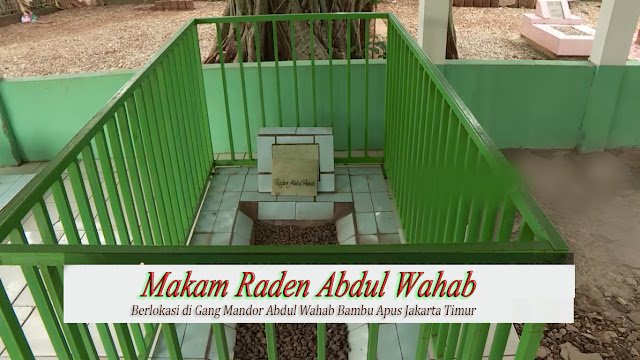
Bambu Apus was then shunned, and the Dutch colonial troops did not even dare to linger in the area until finally, migrants from Banten and Cirebon who were famous for their kanuragan knowledge came to trade in Batavia, some decided to build settlements in the Bambu Apus area, to lead the community. he chose a village head called Mandor, a descendant of Banten nobles named Raden Abdul Wahab, then he was appointed as the first Bambu Apus village head.

According to Mr. Sudirman's narrative, the genealogy of Raden Abdul Wahab's parents was named Raden Abdul Hanan Hidayah Jonggol West Java, then traced again, who at that time had been assisted by the structure of the Banten cultural service, there was a reference that Raden Abdul Hanan had parents named Syaikh Maulana Malik Saifuddin in Pandeglang, Banten, then the parents of Shaykh Maulana Malik Saifuddin namely Prince Muzaki in Citeurep Bogor. Where Prince Muzaki actually has 4 (four) names which include Prince Muzaki and Eyang Sake, meaning Grandmother Sake is called Grandmother for parents and Sake is a drinking bowl made of bamboo.

Under the leadership of Raden Abdul Wahab who was highly knowledgeable, the Bambu Apus area was gradually becoming more and more crowded with residents. For their livelihood, they worked the rice fields and raised goldfish, and the criminals who often acted in Bambu Apus did not dare to show themselves anymore, they did not want to deal with the Banten champions led by Foreman Abdul Wahab.

The Bambu Apus people feel more at home living in an area close to the river, especially as the head of the village Raden Abdul Wahab cares about his people, he often even helps pay off taxes collected by the Dutch government.

Once upon a time, Raden Abdul Wahab had a unique habit with his people, he liked to wear fragrances sourced from the tuberose flower, occasionally he asked permission to take the tuberose flower, and out of nowhere got it when he returned Raden Abdul Wahab was already bringing the fragrant tuberose flower and fragrant, even though in the village of Bambu Apus no one grows tuberose flowers.

The ancestral grave of the Bambu Apus village community is located in Gang Mandor Abdul Wahab Bambu Apus, East Jakarta, right under an old banyan tree hundreds of years old which was planted on the orders of Raden Abdul Wahab. contemplation to hone inner sensitivity, Strangely the roots of the banyan tree did not damage Raden Abdul Wahab's tomb in the slightest, even though the surrounding graves had been damaged by the roots of the banyan tree.

Although the tomb of Raden Abdul Wahab is not very widely known by the community pilgrims, many pilgrims visit this tomb for their own purposes. some have even seen apparitions of the figure of Raden Abdul Wahab, of course, this brings a different experience for the pilgrims.


History of Ancol Development

The old logo and the newest Ancol logo

Starting from Soekarno who wanted Indonesia to have an amusement park. The Ancol project made this happen by transforming swamp areas and shrubs.

Presiden Sukarno dan Guntur Sukarnoputra naik Dumbo di Disneyland, Amerika Serikat, 4 Juni 1956
President Sukarno and Guntur Sukarnoputra ride a Dumbo at Disneyland, United States, June 4, 1956

The above photo courtesy of gettyimages.com dated June 4, 1956, shows President Soekarno and Guntur Soekarno Putra, who was then 12 years old, driving a Dumbo, one of the most exciting rides at Disneyland, United States. During that visit, almost a year after the amusement park opened, Sukarno enjoyed and showed the same enthusiasm as his son.

Soekarno visited Disneyland, Hollywood, and other entertainment venues during a three-week tour in the United States. This is where Soekarno wanted Indonesia to have a similar amusement park. When there was a proposal to turn the swampy and scrubby Ancol area into an industrial area, Soekarno rejected it. He wanted to fulfill his dream, to build the area as a tourist attraction.

According to Sugianto Sastrosoemarto and Budiono in Traces of Soekardjo Hardjosoewirjo at Taman Impian Jaya Ancol, since the 17th century, Ancol has become a tourist area. At that time, Ancol was a beautiful and clean beach area. There stood many rest houses of the Dutch elite. Even the 25th Governor General of the Dutch East Indies Adrian Valckenier (1737-1741) had a large rest house with a large garden.

The situation changed when malaria hit Batavia in the early 19th century. Ancol was not spared from malaria attacks. The Dutch didn't even dare to visit, let alone live, there.

Jakarta historian, Alwi Shahab writes that the abandoned Ancol became a thicket of forest and a monkey nest. At night, the area becomes a place for masher men and commercial sex workers. Wealthy playboy Oey Asia and a number of other rich people often have fun there. They have a Sophia or pleasure house called Bintang Mas. It is said that Oey killed a girl in one of his villas.

“The girl is identified as Ariah who disappeared around 1870/1871. She died and her body disappeared, after refusing to be raped. He later became known as 'The Sweet Ancol Bridge'...," Alwi wrote in "Recreation at the Monkey's Nest," which was published by Republika, on October 30, 2005.

During the Japanese occupation, Ancol was used as a place of execution and a mass grave for those who opposed the Japanese army. On September 14, 1946, the victims were adequately re-buried at the Ancol Cemetery. The cemetery contains more than 2,000 victims, many of whom are unnamed.

After Indonesia's independence, Jakarta began to improve. Ancol, which was previously often referred to as a place where “children throw away jinn”, was transformed into a tourist area through a Presidential Decree regarding the Ancol Project Development Committee and Government Regulation No. 51 of 1960. Soekarno appointed DKI Jakarta Governor Soemarno Sosroatmodjo as the executor of the Ancol Project development.

“Marno, as a leader, you must be able to think about what you can do for your people fifty years from now. You have to be able to imagine what your people, the people of Jakarta, need. Not for the next year or two, but the next fifty, or a hundred years. How can you provide a place that can make the people of Jakarta happy so that residents can enjoy the fresh air of the sea, can see the joy of children playing on the beach, and be touched by the crashing of the waves, and the breezy breeze." That was Soekarno's message to Soemarno which was recorded in Soekardjo's memory.

Soekardjo Hardjosoewirjo was a person who played an important role in the early stages of the realization of the Ancol Project. He drafted presidential letters regarding the Ancol Project development committee; taking care of the completeness of paperwork related to law, budgeting, and studying and completing organizational files for the implementation of the Ancol Project. After a month of working behind a desk at the DKI Jakarta Regional Government office, he was assigned as a field implementer to prepare for the construction of the Ancol Project.

Even though it was handed over to the Regional Government of DKI Jakarta, the project has become a national program because it is part of the modernization of Jakarta as the nation's capital. But the Ancol Project is a mandatory project, whose funding does not burden the state or regional budget. It is a self-propelling project or in Javanese terms, it is called the "poor duck project".

To meet the funding needs, the project relies on loans from the private sector. Because the domestic contractor did not meet the criteria from a technical point of view, let alone financing, work on the Ancol Project was offered to a foreign contractor. Proposals were provided to the United States, Japan, and France. The choice finally fell on the contractor from France, Compagnie Industriale de Travaux (Citra).

Citra is only working on the first phase of construction: filling in swamps, ponds, and scrub forests with approximately 12.5 million cubic meters of material, as well as acquiring 552 hectares of land. The first phase of construction was completed in February 1966.

“It was very fortunate that when the G30S (30 September 1965 Movement) tragedy erupted, the first phase of stockpiling was almost complete. If when the G30S erupted the first phase of this project had not been completed, it is certainly hard to imagine what would have happened," wrote Sugianto and Budiono.

When the political and economic situation gradually improved, the Ancol Project was continued under the leadership of DKI Governor Ali Sadikin, Soemarno's replacement. The construction of Ancol was carried out by PD Pembangunan Jaya. Ciputra as CEO of PT Pembangunan Jaya proposed the concept of development and development of the Ancol area to Ali Sadikin.

"Make Ancol on a par with America's Disneyland," said Ali Sadikin to Ciputra in Ciputra Quantum Leap.

According to Hermawan Kertajaya, Disneyland was approached to build one of its theme parks in Jakarta. But the effort was not successful.

"Even the name cannot be used, even if for example, they don't spend any money on the theme park being built in Jakarta," Hermawan wrote in 100 Corporate Marketing Cases.

Even though they refused, Disneyland opened itself up for Indonesia to learn. When they were about to build Dunia Fantasi (Dufan), the entire Ancol team of architects and technicians was sent to America to see and learn about Disneyland. "It's just that Ancol doesn't imitate Disneyland, but develops its own Indonesian-style fantasies and creations," said Soekardjo as quoted by Sugianto and Budiono.

Ancol continues to develop various Indonesian-flavored recreational rides. This is what is interesting and distinguishes Ancol from the mainstream of world tourism which tends to be Western. However, Ancol is no less than similar amusement parks in the world.

"Currently, Ancol is a tourist area that is included in the top five largest entertainment tourism areas in the world... Ancol is only beaten by Disneyland and Disney World," said Ciputra in the Ciputra Quantum Leap. Sukarno's desire for a tourist object to become the pride of the nation was realized.


November 05, 2022

Digital TV Innovation Provides Latest Services

The Ministry of Communication and Information of the Republic of Indonesia will end Analog TV broadcasts or Analog Switch Off (ASO) no later than November 2, 2022. ASO ends in accordance with the provisions of Law Number 11 of 2020 concerning Job Creation Article 78 Number 3 of the Post, Telecommunication, and Broadcasting Sector (Postelsiar) which is being carried out in stages starting on April 30, 2022.

Special Staff of the Minister of Communication and Information, Rosarita Niken Widiastuti said, in most areas in Indonesia on November 2, 2022, Analog TV broadcasts will be turned off.
So to switch to Digital TV broadcasts in a very easy way, you just need to add a device called a set-top box that is added to an Analog TV set. So Analog TV can be a flat screen that is not yet digital or tube TV so that people can enjoy Digital TV broadcasts," he said, Sunday (20/10/2022) on the sidelines of the Socialization of the New Era of Digital TV Broadcasts entitled "Goodbye to Analog TV Broadcasts: Indonesia is Ready ASO” in Mataram Udayana Gora Earth Park.

He explained, Digital TV broadcasts are not subscription TV or don't pay a month but only once, namely buying a set-top box that is certified by the Indonesian Ministry of Communication and Informatics. Extremely poor households will receive free set-top box assistance from broadcasting institutions providing multiplexing infrastructure (MUX). If later there is a shortage, the government will add it so that the extremely poor households get a set-top box.

For certain areas where set-top box distribution has not yet been completed and infrastructure development is still in progress, the closure of Analog TV broadcasts will be adjusted according to the readiness of the region.

"Meanwhile, for areas where the distribution of set-top boxes for this assistance has not been evenly distributed and is still in the process, it will not be closed yet. But later it will be 100 percent, of course, the Analog TV broadcast will be closed soon, "he said.
Niken appealed to people who can afford to buy a set-top box as soon as possible so they can get better broadcast quality, clearer sound, better pictures, and advanced technology.

The Information and Communication Ministry has carried out socialization on the migration of analog TV to digital TV for more than a year through various events that involve the wider community so that the transition and closure of analog TV to digital TV is massively conveyed.

"Like this morning, the Car Free Day (CFD) event was held simultaneously in 20 cities throughout Indonesia. So we come to the community, inviting the community to joint activities as well as socializing the termination of Analog TV broadcasts," he said.

The former Managing Director of LPP RRI added that there were many benefits to be gained from Digital TV. In addition to good picture quality, this Digital TV switch is also to expand internet access. So that for areas where the internet is still slow or slow, it will no longer exist after the frequency is set, they will get better and faster internet access.

"Communities in NTB and other communities in Indonesia can successfully transition analog TV to digital TV by adding set-top boxes to analog TV in their respective homes," he said.

May 03, 2019

History of the Majapahit Empire

Who doesn't know about the Majapahit kingdom, surely everyone knows or at least has heard of this name. The biggest kingdom with a very famous governor is Patih Gajah Mada.

For more details about the Majapahit Kingdom, let's look at the description below which will explain the history of the Majapahit kingdom in detail from its founding to its collapse.

The Majapahit Kingdom is one of the largest kingdoms in Indonesia which is Hindu in style and is in East Java. This kingdom was founded by King Raden Wijaya who has the title Kertarajasa Jayawardana and is a descendant of Ken Arok, king of Singosari in 1293 AD.

In addition, this kingdom is also touted as a kingdom that has the largest territory in Indonesia, which is in power in Indonesia.

Actually, the Majapahit kingdom was established because of an attack from Jayakatwang (Duke of Kediri) who succeeded in killing the Singosari kingdom, the latter being called Kertanegara, for refusing to pay tribute.

Furthermore, Raden Wijaya (Kertanegara's son-in-law) managed to ask permission from Madura to ask permission from Aryawiraraja. Then Raden Wijaya entitled a forest of interest by Aryawiraraja to be used in his territory and in the end it was created in a new village with the name Majapahit.

Majapahit comes from the word "Maja fruit" and "bitter taste". Not long after the Mongolian troops led by Shis-Pi, Ike-Mise, and Kau Hsing came to Java. Which is none other than with the aim of punishing Kertanegara for refusing to pay tribute to Mongolian troops.
kejayaan-kerajaan-majapahit
Raden Wijaya took advantage of cooperation with Mongolian troops to attack Jayaketwang's troops. And in the end, the Mongolian troops with the help of Raden Wijaya won by killing Jayaketwang. Not long after, Raden Wijaya expelled the Mongolian troops from the land of Java.

The Majapahit Empire reached its peak during the reign of King Hayam Wuruk (1350-1389). The greatness of the kingdom was supported by regular agriculture, smooth and advanced trade, a strong sea transport fleet, and being led by Hayam Wuruk with Gajah Mada as the prime minister.

Under Patih Gajah Mada, Majapahit conquered many other areas. With the spirit of unity he had, and made a Palapa Oath which read "HE WILL NOT EAT PALAPA FRUIT BEFORE SUCCESSFULLY UNITES THE WHOLE REGION".

Mpu Prapanca in his book Negara Kertagama tells about the glorious era of the kingdom in the time of Hayam Wuruk and also the genealogy of the previous king in 1364 Gajah Mada died compiled by Hayam Wuruk in 1389 and the Majapahit kingdom began to decline.

THE GLORY OF MAJAPAHIT
The Majapahit Empire reached its golden age when it was led by Hayam Wuruk with his prime minister Gajah Mada who was famous for the Palapa Oath. Majapahit conquered almost the entire archipelago and spread its wings throughout Southeast Asia. At this time the Malang area was no longer the center of power because it was suspected that it had moved to the Nganjuk area. According to experts in Malang placed a ruler who is called Raja anyway.
kerajaan-majapahit
In Negara Kertagama it is told that Hayam Wuruk as the King of Majapahit made a pilgrimage to the graves of his ancestors (which are located around the Malang area), one of which is near Ken Arok's grave. This shows that although it is not the center of government, Malang is a sacred area because it is the burial ground of the ancestors who are worshiped as Gods.

Several inscriptions and statues left by Majapahit at the peak of Mount Semeru and also on Mount Arjuna show that the area of ​​the mountain is the abode of the Gods and that only the descendants of the king are allowed to set foot in the area. It can be concluded that these various relics are a series that are interconnected even though they are separated by different periods throughout the 7 centuries.

Majapahit collapse
There is a story that Adipati Terung asked Sultan Bintara alias Raden Fatah, who was still his older brother, to face King Brawijaya. But the Sultan of Demak refused because his father was still considered an infidel.

Brawijaya is the King of Majapahit, a Hindu kingdom that once triumphed in Java. Even then Raden Fatah then gathered the coastal regents such as Tuban, Madura, and Surabaya as well as the Sunans to jointly attack the infidel Majapahit.

Soldiers of Islam were deployed to surround the royal capital. Because he was reluctant to fight with his own son, Prabu Brawijaya escaped from the palace with his followers who were still loyal. So when Raden Fatah and his entourage (including the Sunan) arrived, the palace was empty. On Sunan Ampel's advice, to offer all the influence of a non-believer king, Sunan Gresik was appointed king of Majapahit for 40 days. After that, it was handed over to Sultan Bintara to be brought to Demak.

This story is still embellished again, that is, after Majapahit fell, Adipati Terung was assigned to carry the Majapahit king's passband to Demak to later be used as the porch of the mosque. Adipati Bintara was then titled "Senapati Jinbun Ngabdurrahman Panembahan Palembang Sayidina Panatagama".

The story about the invasion of the Majapahit army can be found in "BABAD TANAH JAWI". But a similar story is also found in "Serat Kanda". As mentioned, Adipati Bintara and his followers rebelled against King Brawijaya. The Majapahit army was led by Mahapatih Gajah Mada, Duke of Eggplant and Andayaningrat (Regent of Pengging). Because he was afraid of Sheikh Lemah Abang, his teacher, Kebo Kenanga (Pengging Regent's son) defected to join the enemy. Meanwhile, his brother Kebo Kanigara remained loyal to the King of Brawijaya.

The Demak army under the leadership of Raden Imam was equipped with the magic weapon "Keris Makripat" given by Sunan Giri which can expel beetle pests and "Badhong" gifted by Sunan Cirebon which can bring storms. The Majapahit army was successfully beaten back to the capital, and only the Duke of Terung's house survived because he embraced Islam.

Due to the urgency, Prabu Brawijaya fled to (Tanjung) Sengguruh and his family accompanied by Patih Gajah Mada. It happened in 1399 Saka or 1477 AD. After being crowned the Sultan of Demak with the title "Panembahan Jinbun", the Adipati Bintara sent Lembu Peteng and jaran panoleh to sengguruh asking the King to convert to Islam. but he still refused. Finally, Sengguruh was attacked and Prabu Brawijaya fled to the island of Bali.

The story versions of BABAD TANAH JAWI and SERAT KANDA are popular among the Javanese people and have even been taught in some elementary schools in the past. Broadly speaking, the story can be said to show the victory of Islam. In fact, on the contrary, it can give a detrimental impression, because it seems as if Islam was developing in Java with violence and blood. In fact, this is not the case.

In addition to other facts, many reveal that Islam entered and developed in Java in a peaceful way. Also, the fact that the collapse of Majapahit also shows that it was not caused by the invasion of the Demak Islamic army.

Prof. Dr. Slamet Muljana in his book "Persada Restoration of the History of the Ancestors of Majapahit" extensively refutes the contents of the story based on historical evidence. It is said that the Babad Tanah Jawi and Serat Kanda were written in the XVII century at the time of Mataram without consulting reliable historical sources. These historical sources include several inscriptions and historical works about Majapahit, such as "Negara Kertagama and Pararaton". Because it is not surprising that many of his descriptions of Majapahit are flawed.

The "Plate Inscription" and "Trailokyapuri" explain that the last Majapahit king, Dyah Suraprahawa, collapsed as a result of an attack by a rivet army led by Girindrawardhana in 1478 AD, according to Pararaton. Since then Majapahit has ceased to be the capital of the kingdom. Thus it is impossible for Majapahit to collapse because of the Demak invasion. Portuguese historical sources written by Tome Pires also mention that the Kingdom of Demak was already established during the reign of Girindra Wardhana in Keling.

At that time Tuban, Gresik, Surabaya, and Madura as well as several other cities on the north coast of Java were in the territory of the kingdom of Kediri, so it was impossible, as told in the Chronicle of Java, Raden Patah gathered the regents to attack Majapahit.

The composers of the Babad Tanah Jawi seem to have mixed up the formation of the Demak kingdom in 1478 and the fall of Kediri by the Demak invasion during the reign of Sultan Trenggano in 1527. The raid on Sultan Trenggano was carried out because Kediri had relations with the Portuguese in Malacca, as reported by Tome Pires. Demak, who was indeed hostile to the Portuguese, so that he attacked Malacca, was not willing that Kediri have relations with the colonial nation.

After Kediri fell (not Majapahit!) attacked by Demak, they didn't flee to the island of Bali as mentioned in the description of Serat Kanda, but to Panarukan, Situbondo after Sengguruh, Malang. It could be that some fled to Bali so that until now the Balinese have Hindu culture, but that was not the escape of the last king of Majapahit, as mentioned in the Chronicle. More specifically, Raden Patah was not the son of the last Majapahit King as mentioned in the Chronicle and Serat Kanda, said Dr. Slamet Muljana.

Historian Mr. Moh. Yamin in his book "Gajah Mada" also mentions that the collapse of Brawijaya V, the last Majapahit king, was due to an attack by Ranawijaya from the Keling kingdom, so it was not an attack from Demak. The description of Mahapatih Gajah Mada's involvement in leading the Majapahit army when it was attacked by Demak in 1478 is contrary to history.

Gajah Mada had died in 1364 AD or 1286 Saka.
The narrative of the book "From the Historical Stage" translated by IP Simanjuntak sourced from the writings of H.J. Van Den Berg also found that the fall of Majapahit was not the result of an attack from Demak or the Islamic army. Ma Huan, a Chinese Muslim writer, in his book "Ying Yai Sheng Lan" mentioned, when he visited Majapahit in 1413 AD he had mentioned that the Muslim community living in Majapahit came from Gujarat and Malacca. He mentioned, in 1400 AD Islamic merchants from Gujarat and Persia had settled on the north coast of Java.

One of them is Maulana Malik Ibrahim who is buried in Pasarean Gapura Wetan Kab. Gresik with the year 12 Rabi'ul Awwal 882 H or April 8, 1419, AD, means that during the reign of Wikramawardhana (1389-1429) namely King Majapahit IV after Hayam Wuruk. According to Tjokrosujono (former head of the Historical and Antiquities Sanctuary, Mojokerto), the tombstone engraved with Arabic calligraphy is an original tombstone, not a new one.

One proof that since the Majapahit era there has been a Muslim settlement in the capital city, is the Ancient Troloyo Tomb site, Trowulan District, Mojokerto, East Java. The Islamic graves at the Troloyo site, Sentonorejo Village, have various year numbers, starting from 1369 (XIV century AD) to 1611 (XVII century AD).

The gravestones of the petilasan graves in Troloyo are full of Arabic inscriptions that look like inscriptions. The pronunciation is taken from prayer readings, Kalimah Thayibah, and excerpts from Al-Quran verses with slightly stiff letters. It appears the maker was a convert to Islam. The contents are not data on the birth and death of the buried figures, but are more preachy in nature, including quotations from Surah Ar-Rahman verses 26-27.

P.J. Veth was a Dutch scholar who first researched and wrote about Troloyo's tomb in the book JAVA II in 1873.

L.C. Damais, a French researcher who followed him, mentioned the year numbers on the tombstones from the XIV to XVI centuries. Soeyono Wisnoewhardono, Staff of the Historical and Archaeological Heritage Sanctuary in Trowulan said the graves proved that when the Majapahit kingdom was still standing, Muslims had lived peacefully around the capital city. It is clear here that Islam entered the land of Majapahit, full of peace and tolerance.

Another archaeological site in the Trowulan sub-district, namely in the village and Trowulan sub-district, is the Putri Cempa Tomb. According to the Babad Tanah Jawi, Putri Cempa (Jeumpa, Acehnese) was the wife of Prabu Brawijaya who was a Muslim. The two gravestones found in this ancient complex date to 1370 Saka (1448 AD) and 1313 Saka (1391 AD).

In folk legend, it is said that by marrying Princess Cempa, the King had actually embraced Islam. When he died he was buried according to Islam in a long grave (Kubur Dawa). Dusun Upload is 300 meters from the tomb of Putri Cempa, the Islamic aristocrat.

From these historical facts and sites, there is authentic evidence about how it is not true that Islam was developed through war. In fact, several other historical sites prove that Islam was very tolerant of other religions (including Hinduism) when Islam was growing rapidly in Java.

In the Sunan Bonang complex in Tuban, East Java, for example, there is an upright Shiva Buddhist temple with the year 1400 Saka (1478 AD) which is now located behind the Tuban Regional Government office. In fact, at that time Sunan Bonang's Islamic boarding school had been established. The Islamic boarding school and the adjacent temple are preserved in a small model made of old wood which is now stored in the Kambang Putih Museum, Tuban.

In Kudus, Central Java, when Sunan Kudus Ja'far Sodiq spread Islamic teachings there, he forbade Muslims to slaughter cows for food. Although beef is halal according to Islam, slaughtering is forbidden to respect the beliefs of Hindus who venerate cows.

To show his tolerance for Hindus, Sunan Kudus tethered a cow in the courtyard of the mosque where it is still preserved today. Even the minaret of the Kudus Mosque was built in the architectural style of a Hindu temple.

when the Majapahit kingdom stood as part of the journey of the Indonesian nation. Since the founding of Raden Wijaya, who has the title Kertanegara Dharmawangsa, this kingdom has always been filled with the phenomenon of rebellion.

Heir to the throne of Raden Wijaya, namely during the reign of Kalagemet / Jayanegara (1309-1328), which is an inscription is considered as the incarnation of Wisnu with the Minadwaya state badge (two fish) in governing faced many rebellions against Majapahit from those who were still loyal to Kertarajasa.

The first rebellion actually started when Kertarajasa was still alive, namely by Rangga Lawe who was based in Tuban, due to dissatisfaction because he was not the governor of Majapahit but Nambi, son of Wiraraja. But his attempt (1309) was thwarted.

The second rebellion was in 1311 by Sora, a rakryan in Majapahit, but failed. Then the third was in 1316, by his own prime minister, namely Nambi, from the Lumajang area and the fort in Pajarakan. His whole family was annihilated.

The next rebellion by Kuti in 1319, where the capital of Majapahit was occupied, the king fled under the protection of palace guards called Bhayangkari as many as 15 people under the leadership of Gajah Mada.

However, with the help of Majapahit troops who were still loyal, Gajah Mada and his Bhayangkari attacked Kuti, and finally Jayanegara was able to continue his reign.

After the Kuti rebellion ended, in 1331 a rebellion appeared in Sadeng and Keta (Besuki area). So the Majapahit governor Pu Naga was replaced by the governor of Daha, namely Gajah Mada, so the rebellion was crushed. Gajah Mada's success in quelling the Sadeng rebellion led him to a career as a royal governor.

However, during the reign of Hayam Wuruk in 1350-1389, the prime minister Gajah Mada – who was also the warlord at that time – had to exhaust his energy to quell rebellions in several areas. Ronggolawe rebellion until the attack on the kingdom of Dhaha, Kediri.

In fact, one of the causes of the decline and destruction of the Majapahit empire was when the outbreak of the Paragreg War in 1401-1406 was a civil war for power, subordinate regions began to break away, and the development of Islam in coastal areas.

The Majapahit Empire, which had experienced its golden and glorious era, had to fall apart after losing great figures such as Hayam Wuruk and Gajah Mada.

Kings who once ruled the Majapahit Kingdom:
1. Raden Wijaya 1273 – 1309
2. Jayanegara 1309-1328
3. Tribhuwanatunggaldewi 1328-1350
4. Hayam Wuruk 1350-1389
5. Wikramawardana 1389-1429
6. Kertabhumi 1429-1478

Causes of decline
Majapahit lost major figures such as Hayam Wuruk and Gajah Mada. The outbreak of the Paragreg War in 1401-1406 was a civil war over the power of subordinate regions, which began to break away.

Relics of the Majapahit kingdom
- Buildings: Panataran Temple, Sawentar, Tiga Wangi, Muara Takus
- Book: Negara Kertagama by Mpu Prapanca, Sitosoma by Mpu Tantular which contains the slogan Bhinneka Tunggal Ika.

Paraton Kidung Sundayana and Sorandaka R Wijaya Get the Inspiration to Establish the Majapahit Kingdom.

Two banyan trees at the entrance of the Great Hall in Trowulan, Mojokerto. The two banyan trees were planted on December 22, 1973, by the Regional Military Commander Widjojo Soejono and Governor Mohammad Noer.

Behind the Pendopo Agung building which has a photo of the Brawijaya Military Commander, there is a small building surrounded by public graves. The building, named Petilasan Panggung, is believed to be Raden Wijaya's Petilasan and the place where Patih Gajah Mada announced the Palapa Oath.

As soon as you enter the Petilasan Panggung building, which has a mini pavilion as a backdrop, you can see several rocks shaped like graves, the walls around the "grave" are covered with a transparent white mosquito net which adds to the sacredness of the place.

According to Sajadu (53), the caretaker of the Petilasan Panggung, this is where Raden Wijaya meditated until he finally received the inspiration to establish the Majapahit kingdom. Apart from that, it was also at this place that Patih Gajah Mada announced the Palapa Oath. "This place is sacred because it is considered the Anya of the Majapahit Kingdom," he said.

At certain times especially coinciding with Legi Friday night, many people come to pray and hope for blessings. "People come to pray so that the goal is achieved," said Sajadu, who stated that the job of guarding the Petilasan Stage had been done for generations since his ancestors.

While smoking his kretek cigarettes, the man who inherited as caretaker of the petilasan from his father since 1985 also recounted that the place used to be just a pile of rocks. Until now, the stone is still inside, he said.

Then in 1964, Mrs. Sudarijah, also known as Mrs. Dar Moeriar from Surabaya, carried out the restoration for the first time. It was only in 1995 that it was restored again by the Brawijaya Regional Military Commander, who at that time was held by Utomo.

Entering the Petilasan Stage area, a picture of Gajah Mada is displayed right beside the entrance. While on the front of the door hangs a small board with the words "Five Guidelines" which is a role model guide for residents.

In full, "Poncho Waliko" reads "Kudutrisno Marang Sepadane Urip, Ora Pareng Ngilik Sing Dudu Semestine, Ora Pareng Sepatah Nepatani and Ora Pareng Eidra Hing Ubaya"

Sajadu also recounted that the Petilasan Stage was declared closed to the public from 1985 to 1995. It was only after that that it was opened again to the public.

History of the University of Indonesia

The University of Indonesia is a modern, comprehensive, open, multicultural, and humanist campus that covers a broad range of disciplines. UI is currently simultaneously trying to become one of the leading research universities or academic institutions in the world. As a research university, efforts to achieve the highest achievements in terms of discovery, development, and diffusion of knowledge regionally and globally are always carried out. Meanwhile, UI has also deepened its commitment to its efforts in the field of academic development and research activities through a number of disciplines within its scope.

History The forerunner of the University of Indonesia began in 1849 and the University of Indonesia is a representative educational institution with the oldest history in Asia. Having produced more than 400,000 alumni, Universitas Indonesia continues to play an important role at the national and world levels. However, UI cannot escape from its current mission of becoming a high-quality educational institution, world-standard research, and maintaining prestige standards in a number of international journals.

Dutch Occupation Period (1849-1946)
The Dutch Colonial Government 1849 built a university which was later named Dokter-Djawa School (School of Medicine for Javanese) in January 1851, this high school specializing in medical science.

After experiencing a name change at the end of the 19th century, in 1898 to be precise, the name Dokter-Djawa School changed to School tot Opleiding van Indische Artsen (School of Medicine for Indigenous Doctors) or STEVIA. For 75 years STEVIA served as the best educational place for aspiring doctors in Indonesia before it was closed in 1927.

However, a medical school was later built together with four other high schools in several cities in Java. The high schools were Technische Hogeschool te Bandoeng (Faculty of Engineering) which was established in Bandung in 1920, Recht Hoogeschool (Faculty of Law) in Batavia in 1924, Faculteit der Letteren en Wijsbegeerte (Faculty of Literature and Humanities) in Batavia in 1940, and a year later they were built Faculteit van Landbouwweteschap (Faculty of Agriculture) in Bogor.

These five high schools were the pillars in creating the Good-Universiteit (Emergency University), which was founded in 1946.

Doctor Java School
Age of Independence (1947-the 1960s)
Nood-universiteit changed its name to Universiteit van Indonesie in 1947 and was based in Jakarta. Several nationalist professors, one of whom is Prof. Mr. Djokosoetono, continued his function as a lecturer for Universiteit van Indonesia in Yogyakarta, then the nation's capital.

The Indonesian capital then returned to Jakarta in 1949 after the Dutch recognized the sovereignty of the Republic of Indonesia. Universiteit van Indonesia Yogjakarta also moved again to Jakarta.

Universiteit van Indonesië was later merged into "Universiteit Indonesia" in 1950. This university has a Faculty of Medicine, Law, Letters, and Philosophy in Jakarta, a Faculty of Engineering located in Bandung, a Faculty of Agriculture in Bogor, a Faculty of Dentistry in Surabaya, and a Faculty of Economics in Makassar.

Faculties outside Jakarta then developed into separate universities between 1954-1963. The University of Indonesia in Jakarta has a campus in Salemba and consists of several faculties such as Medicine, Dentistry, Mathematics and Natural Sciences, Literature, Law, Economics, and Engineering.

In subsequent developments, the Faculty of Psychology, Faculty of Social and Political Sciences, Public Health, Computer Science, and then the Faculty of Nursing were established.

Doctor Java School
Modern Age (1970s-present)
Before the University of Indonesia campus in Depok was built in 1987, the University of Indonesia had three campus locations namely in Salemba, East Pegangsaan, and Rawamangun. After the new campus was established on 320 hectares of land in Depok, the Rawamangun campus was moved while the Salemba campus was still maintained for the Faculty of Medicine, Dentistry, and Postgraduate Programs.

Not long after 2000, the University of Indonesia became one of several universities with the status of a State Owned Legal Entity in Indonesia. This change in status brought significant changes to the University of Indonesia, namely greater autonomy in academic development and financial management so that the university grew to become a world-class university.

From this historical perspective, the University of Indonesia has grown progressively into an institution that aims to become a leader in the fields of humanity and civilization by balancing academic values, morality, and art. Through these advantages, the University of Indonesia intends to turn the Indonesian nation into a more prosperous and democratic society, with a focus on peace, justice, and strong environmental values.

THE UNIVERSITY OF INDONESIA
1849-1898 Doctordjawaschool Batavia
1898-1927 School tot Opleiding van Indische Artsen, Batavia
1909-1929 Opleidingschool voor Inlandsche Rechtskundigen, Batavia
1913-1942 Nederlandsch-Indische Veeartsenschool, Buitenzorg
1920-1921 Technische Hoogeschool, Bandoeng
1922-1924 Rechtschool, Batavia
1924-1942 Rechts-hoogeschool, Batavia
1924-1942 Technische-Hoogeschool, Bandoeng
1927-1942 Geneeskundige Hoogeschool, Batavia
1940-1942 Faculteit der Letteren en Wijsbegeerte, Batavia
1941-1942 Faculteit der Landbouwwetenschap, Batavia
1943-1945 Djakarta Ika Daigaku
1944-1945 Bandoeng Koogyo Daigaku

1945-1950
University Hall of the Republic of Indonesia
1. College of Medicine, Jakarta
2. College of Law/Literature, Jakarta

1946-1947
Nood-Universiteit
1. Geneekundige Faculteit
2. Juncdiche Facultein
3. Faculteit der Letter en Wijbegerts
4. Technische Faculteit
5. Landbouwkundige Faculteit

University Hall of the Republic of Indonesia
1. College of Medicine, Jakarta
2. College of Law/Literature, Jakarta

1947-1950
Good-Universiteit
1. Faculteit der Geneekundige, Batavia
2. Faculteit van Technische Wetenschap, Bandoeng
3. Faculteit der Rechtsgekerdeid end canSociale Wetenschap, Batavia
4. Faculteit der Letter en Wijbegerts, Batavia
5. Faculteit van Landbouwwatenschap, Buitenzorg
6. Faculteit der Exacte Wetenschap - later the name was changed to Faculteit van Wiskunde en Natuurewtenschap, Bandung
7. Diergeneschundige Faculteit, Buitenzorg
8. Faculteit der Economiche Wetenschap, Makasar
9. Faculty of Geneskunde, Soerabaja
10. Other faculties whose types and places are determined by the Governor General

University Hall of the Republic of Indonesia
1. College of Medicine, Jakarta
2. College of Law/Literature, Jakarta

February 1950
Universiteit Indonesia/University Hall of the Republic of Indonesia
1. Faculty of Medicine & Physical Education Institute, Jakarta
2. Faculty of Law and Community Science, Jakarta
3. Faculty of Letters and Philosophy, Jakarta
4. Faculty of Agriculture, Bogor
5. Faculty of Veterinary Medicine, Bogor
6. Faculty of Science. Engineering & Drawing Teacher Pend Institute, Bandung
7. Faculty of Exact Sciences and Natural Sciences, Bandung
8. Faculty of Medicine and Dentistry Institute, Surabaya
9. Faculty of Economics, Makassar (temporarily closed)

February 1950-1954
Universiteit Indonesie/Higher Education Center of the Republic of Indonesia
1. Faculty of Medicine & Physical Education Institute, Jakarta
2. Faculty of Law and Community Science, Jakarta
3. Faculty of Letters and Philosophy, Jakarta
4. Faculty of Economics, Jakarta
5. Faculty of Agriculture, Bogor
6. Faculty of Veterinary Medicine, Bogor
7. Faculty of Science. Engineering & Drawing Teacher Pend Institute, Bandung
8. Faculty of Exact Sciences and Natural Sciences, Bandung
9. Faculty of Medicine and Dentistry Institute, Surabaya
10. Branch of the Faculty of Law and Community Service from FH & PM UI Jakarta, Makassar
11. Faculty of Economics as a branch of the Faculty of Economics UI Jakarta, Makassar

1954-1955
University of Indonesia
1. Faculty of Medicine & Physical Education Institute, Jakarta
2. Faculty of Law and Community Science, Jakarta
3. Faculty of Letters and Philosophy, Jakarta
4. Faculty of Economics, Jakarta
5. Faculty of Agriculture, Bogor
6. Faculty of Veterinary Medicine, Bogor
7. Faculty of Science. Engineering & Drawing Teacher Pend Institute, Bandung
8. Faculty of Exact Sciences and Natural Sciences, Bandung
9. Faculty of Medicine and Dentistry Institute, Surabaya
10. Faculty of Economics, Makassar
11. Faculty of Law, Makassar

1955-1956
University of Indonesia
1. Faculty of Medicine & Physical Education Institute, Jakarta
2. Faculty of Law and Community Science, Jakarta
3. Faculty of Letters and Philosophy, Jakarta
4. Faculty of Economics, Jakarta
5. Faculty of Agriculture, Bogor
6. Faculty of Veterinary Medicine, Bogor
7. Faculty of Science. Engineering & Drawing Teacher Pend Institute, Bandung
8. Faculty of Exact Sciences and Natural Sciences, Bandung
9. Faculty of Economics, Makasar
10. Faculty of Law, Makasar

1956-1959
University of Indonesia
1. Faculty of Medicine & Physical Education Institute, Jakarta
2. Faculty of Law and Community Science, Jakarta
3. Faculty of Letters and Philosophy, Jakarta
4. Faculty of Economics, Jakarta
5. Faculty of Agriculture, Bogor
6. Faculty of Veterinary Medicine, Bogor
7. Faculty of Science. Engineering & Drawing Teacher Pend Institute, Bandung
8. Faculty of Exact Sciences and Natural Sciences, Bandung

1959-1963
University of Indonesia
1. Faculty of Medicine, Jakarta
2. Faculty of Law and Community Science, Jakarta
3. Faculty of Letters, Jakarta
4. Faculty of Economics, Jakarta
5. Faculty of Psychology, Jakarta
6. Faculty of Dentistry, Jakarta
7. Faculty of Exact Sciences and Natural Sciences, Jakarta
8. Faculty of Teacher Training and Education, Jakarta
9. Faculty of Agriculture, Bogor
10. Faculty of Veterinary Medicine, Bogor

1963-1987
University of Indonesia
1. Faculty of Medicine, Jakarta
2. Faculty of Law and Community Science, Jakarta
3. Faculty of Letters, Jakarta
4. Faculty of Economics, Jakarta
5. Faculty of Psychology, Jakarta
6. Faculty of Dentistry, Jakarta
7. Faculty of Exact Sciences and Natural Sciences, Jakarta
8. Faculty of Engineering, Jakarta
9. Faculty of Public Health, Jakarta
10. Faculty of Social and Political Sciences, Jakarta
11. Non-Degree Faculty of Economics, Jakarta
12. Non-Degree Faculty of Technology, Jakarta 
13. Postgraduate Faculty, Jakarta

1987-2007
University of Indonesia
1. Faculty of Medicine, Salemba Campus - Jakarta
2. Faculty of Law and Community Science, Depok Campus
3. Faculty of Letters, Depok Campus
4. Faculty of Economics, Depok Campus
5. Faculty of Psychology, Depok Campus
6. Faculty of Dentistry, Salemba Campus - Jakarta
7. Faculty of Exact Sciences and Natural Sciences, Depok Campus
8. Faculty of Engineering, Depok Campus
9. Faculty of Public Health, Depok Campus
10. Faculty of Social and Political Sciences, Depok Campus
11. Faculty of Computer Science, Depok Campus
12. Faculty of Nursing, Depok Campus
13. Postgraduate Faculty, Salemba Campus - Jakarta

2007-2011
University of Indonesia
1. Faculty of Medicine, Salemba Campus - Jakarta
2. Faculty of Law and Community Science, Depok Campus
3. Faculty of Letters, Depok Campus
4. Faculty of Economics, Depok Campus
5. Faculty of Psychology, Depok Campus
6. Faculty of Dentistry, Salemba Campus - Jakarta
7. Faculty of Exact Sciences and Natural Sciences, Depok Campus
8. Faculty of Engineering, Depok Campus
9. Faculty of Public Health, Depok Campus
10. Faculty of Social and Political Sciences, Depok Campus
11. Faculty of Computer Science, Depok Campus
12. Faculty of Nursing, Depok Campus
13. Postgraduate Faculty, Salemba Campus - Jakarta
14. Vocational Education Program, Depok Campus


History of Mount Krakatau Indonesia

sejarah gunung krakatau
In the beginning, the big island of Krakatau, which we usually call by the name of Mount Krakatau, was a mountain (ancient Mount Krakatau) which has a height of about 2000 meters above sea level with a circle of beaches of about 11 km and a radius of about 9 km2.

However, the devastating explosion that occurred around 416 AD destroyed three-quarters of the body of the mountain and left three large islands, namely Sertung Island, Rakata Island and Panjang Island, as well as a caldera in the middle of the three islands. Before 1883, two clusters of mountains appeared, named Mount Danan and Mount Perbuatan, which later united with Rakata Island and were commonly referred to as Mount Krakatau.

In 1880, the so-called Strombolian period, volcanic activity continued for several months, and Mount Perbuatan actively spewed lava. After that period, there was no volcanic activity until finally signs of an impending eruption appeared in May 1883.

Then on August 27, 1883 Mount Krakatau erupted. According to historical records, which until now have always been promoted by Lampung tourism ranks, Mount Krakatau erupted very violently, shaking the world. eruptions of lava and ash reached a height of 80 km. While the ashes surround the earth for several years. seen from North America and Europe, at that time the sun looks blue and the moon looks orange (orange).

This volcanic eruption produces great dust that can penetrate a distance of up to 90 km. The eruption also had an impact on sea waves up to 40 m vertically and has claimed around 36,000 lives in 165 villages both in South Lampung and west of West Java. And because of the eruption it has obliterated Mount Danan and Perbuatan from the face of the earth and left three islands namely Panjang Island, Sertung Island, and Rakata Besar Island as well as a caldera which is located in the middle of the three islands with a diameter of 7 km.

Forty years later a new miracle was born. Around 1927 the fishermen who were going to sea in the Sunda Strait were suddenly surprised. A plume of black smoke on the surface of the sea immediately appeared between the three islands, namely in the caldera, which was the site of the previous violent eruption. Then on December 29, 1929 a crater wall appeared to sea level which was also the source of the eruption. Only two years after the mysterious puff of smoke in the sea, then a strange object appeared. The original "face" of this strange object became clearer and clearer day by day and it turned out that it was what was later called Mount Anak Krakatau.

But the mystery of Mount Anak Krakatau doesn't end there. This mountain has its own uniqueness, because this mountain always adds about one inch in height every day. Mount Anak Krakatau, which was originally only a few meters away, can now reach 230 meters above sea level and has since appeared in 1927. This mountain was recorded to have erupted about 16 times from December 1927 to August 1930 and 43 times from 1931-1960 and 13 times from 1961-2000.

(Quoted from various sources with processing)

History of the Kutai Kingdom in East Kalimantan

kerajaan-kutai
The Kutai Kingdom is the oldest kingdom in Indonesia. This kingdom is located on the banks of the Mahakam river in Muarakaman, East Kalimantan, near the town of Tenggarong.

Dynasty Founder
It is estimated that the Kingdom of Kutai was founded in the 4th century AD. The inscription was erected by King Mulawarman. Historical evidence about the Kutai kingdom is the discovery of seven inscriptions in the form of yuba (stone pillars) written on yuba using Pallawa letters and Sanskrit.

The contents of the inscription stated that the first king of the Kingdom of Kutai was named Kudungga. He has a son named Asawarman who is referred to as wamsakerta (family maker). After he died, Asawarman was replaced by Mulawarman. The use of the name Asawarman and the names of the kings in subsequent generations shows that the influence of Hindu teachings had entered the Kutai kingdom and this proves that the Kutai kings were native Indonesians who had embraced Hinduism.

Kingdom Life
Social life in the Kingdom of Kutai is a translation of the inscriptions found by experts. Among these translations are the following:
- Society in the Kingdom of Kutai is organized, orderly and orderly
- People in the Kingdom of Kutai have the ability to adapt to foreign cultures (India) and follow the changing patterns of the times while maintaining and preserving their own culture.

Economic life in the Kingdom of Kutai can be known from the following two things:
The geographical location of the Kutai Kingdom is on the trade routes between China and India. The Kingdom of Kutai became an interesting place for merchants to stop by. This shows that trading activities have become part of the life of the Kutai people, in addition to agriculture.

Written information on the inscription says that King Mulawarman once gave his wealth in the form of oil and 20,000 cows to the Brahmins.

The cultural life of the Kutai people is as follows:
- The people of Kutai are people who maintain the roots of their ancestral cultural traditions.
- People who are very responsive to changes and cultural progress.
- Uphold religious spirit in their cultural life.

Entry of Cultural Influence
The influx of Indian cultural influence into the archipelago caused Indonesian culture to change. The most important change is the emergence of a government system with a king as its head. Before Indian culture entered, the government was only led by a tribal chief.

Apart from that, another mix-up is the life of the ancestors of the Indonesian people who built stone monuments. This habit shows that in accepting foreign cultural elements, the Indonesian people are active. This means that the Indonesian people are trying to find and adapt these foreign cultural elements to their own culture.

The Indonesian people have a habit of erecting stone monuments, called menhirs, for the worship of ancestral spirits, while the stone monuments (Yupa) erected by King Mulawarman are used to tie up sacrificial animals.

The inscription also tells that King Mulawaraman ruled wisely. He once presented ± 20,000 cows for sacrifice to brahmins/priests. And the inscription also stated that King Aswawarman was the founder of the dynasty, why wasn't his father Kudungga the founder of the dynasty but his son Aswawarman? This was because at that time King Kudungga had not embraced Hinduism, so he could not become the founder of the Hindu dynasty.

From King, Aswawarman descended to Mulawarman, because Mulawarman also embraced Hinduism. This is known from the mention of the sacred building for God Trimurti. The building is called the Wapraskewara building and in the Kembeng Cave in the interior of Kutai, there are a number of Hindu religious statues such as Shiva and Ganesha.

Legacy Evidence
Historical evidence of the Kutai Kingdom is the discovery of seven inscriptions in the form of Yupa (stone pillars)

History of the Kingdom of Kediri

The Kingdom of Kediri is a large kingdom in East Java that was founded in the 12th century. This kingdom is part of the Ancient Mataram Kingdom. The center of his empire was located on the banks of the Brantas River, which at that time had become a busy shipping lane.

Establishment of the Kingdom of Kediri
The discovery of the Tondowongso Site in early 2007, which is believed to be a relic of the Kingdom of Kediri, is expected to help provide more information about the kingdom. Several ancient statues from the Kingdom of Kediri. The statue found in Gayam village, Kediri is classified as rare because it is the first time a statue of the four-faced or Catur Muka Shiva god Shiva has been found.

In 1041 or 963 AD King Airlangga ordered the dividing of the kingdom into two parts. The division of the kingdom was carried out by a Brahmin who was known for his supernatural powers, namely Mpu Bharata. The two kingdoms known as Kahuripan became Jenggala (Kahuripan) and Panjalu (Kediri) which were bounded by Mount Kawi and the Brantas river were told in the Mahaksubya inscription (1289 AD), the book Negarakertagama (1365 AD), and the Calon Arang book (1540 AD). The purpose of dividing the kingdom into two is to avoid conflict.

The Jenggala Kingdom covered the Malang area and the Brantas river delta with its ports in Surabaya, Rembang, and Pasuruhan, the capital city being Kahuripan, while Panjalu was later known as Kediri including Kediri, Madiun and the capital city Daha. Based on the inscriptions found, each kingdom felt entitled to the entire throne of Airlangga, so war broke out.

At the end of November 1042, Airlangga was forced to divide his kingdom because his two sons competed for the throne. A son named Sri Samarawijaya got a western kingdom called Panjalu which was centered in a new city, namely Daha. Meanwhile, the son named Mapanji Garasakan got an eastern kingdom named Janggala which was based in the old city, namely Kahuripan. Panjalu was controlled by Jenggala and the name of Raja Mapanji Garasakan (1042-1052 AD) was immortalized in the Malenga inscription. He still wears the symbol of the Kingdom of Airlangga, namely Garuda Mukha.

At first, the civil war was won by Jenggala but in the subsequent developments, it was Panjalu/Kediri who won the war and controlled the entire throne of Airlangga. Thus in East Java stood the kingdom of Kediri where evidence explaining this kingdom, in addition to the discovery of inscriptions also through literary books. And what explains a lot about the Kediri kingdom is the work in the form of literary books. The result of this literary work is the book Kakawin Bharatayudha written by Mpu Sedah and Mpu Panuluh which tells about the victory of Kediri/Panjalu over Jenggala.

Development of the Kingdom of Kediri
In its development, the Kingdom of Kediri, which had the capital of Daha, grew to a large extent, while the Kingdom of Jenggala sank. Allegedly the Kingdom of Jenggala was conquered by Kediri. However, the loss of Jenggala traces may also be due to the absence of inscriptions left behind or the inscriptions left by the Jenggala Kingdom that have not been found. The glory of the Kingdom of Kediri had fallen when King Kertajaya (1185-1222) clashed with the clergy. Akuwu Tumapel Tunggul Ametung took advantage of this situation.

But then his position was taken by Ken Arok. It was in this former Kediri Kingdom that Ken Arok later founded the Singasari Kingdom, and Kediri came under Singasari's rule. When Singasari was under the reign of Kertanegara (1268-1292), there was an upheaval within the kingdom. Jayakatwang, the king of Kediri who had been submissive to Singasari, joined forces with the Regent of Sumenep (Madura) to bring down Kertanegara. Finally, in 1292 Jayakatwang succeeded in defeating Kertanegara and rebuilding the glory of the Kediri Kingdom.

The political development of the kingdom of Kediri
Mapanji Garasakan reigned shortly. He was succeeded by King Mapanji Alanjung (1052 – 1059 AD). Mapanji Alanjung was later replaced again by Sri Maharaja Samarotsaha. The continuous fighting between Jenggala and Panjalu resulted in no clear news about the two kingdoms for 60 years until the name of King Bameswara (1116 – 1135 AD) from Kediri emerged.

At that time the capital city of Panjalu had been moved from Daha to Kediri so this kingdom was better known as the Kingdom of Kediri. King Bameswara wore a royal badge in the form of a fanged skull above the crescent moon which is commonly called Candrakapala. After Bameswara stepped down from the throne, he was replaced by Jayabaya, who during his reign succeeded in defeating Jenggala. Successively the kings of Kediri since Jayabaya were as follows.

In 1019 AD Airlangga has crowned the king of Medang Kamulan. Airlangga tried to restore Medang Kamulan's authority, after the royal authority was restored, Airlangga moved the center of government from Medang Kamulan to Kahuripan. Thanks to his hard work, Medang Kamulan achieved glory and prosperity. Towards the end of his life, Airlangga decided to resign from the government and became a hermit known as Resi Gentayu. Airlangga died in 1049 AD.

The heir to the Medang Kamulan royal throne should be a daughter, namely Sri Sanggramawijaya who was born from a consort. However, because he chose to become a hermit, the throne was passed to Airlangga's son who was born from a concubine.

To avoid civil war, Medang Kamulan was divided into two, namely the kingdom of Jenggala with the capital Kahuripan, and the kingdom of Kediri (Panjalu) with the capital D haha. But the effort failed. This can be seen until the 12th century when Kediri remained a fertile and prosperous kingdom but was not completely peaceful due to the overshadowing of Jenggala which was in a weaker position. It made a dark atmosphere, full of hypocrisy, and murder took place against princes and kings between the two countries. However, this feud ended in the defeat of Jenggala, and the kingdom was reunited under the rule of Kediri.

KEDIRI KINGDOM GOVERNMENT SYSTEM
The government system of the Kediri kingdom saw several changes of power, while the kings who had ruled during the Kediri kingdom were: Shri Jayawarsa Digjaya Shastraprabhu.

Jayawarsa was the first king of the Kediri kingdom with an inscription dated 1104. He called himself the incarnation of Vishnu.

Kameshwara
The second king of the Kediri kingdom who had the title Sri Maharajarake Sirikan Shri Kameshwara Sakalabhuwanatushtikarana Sarwwaniwaryyawiryya Parakrama Digjayottunggadewa, better known as Kameshwara I (1115-1130). His royal symbol is a fanged skull called Candrakapala. During his reign, Mpu Darmaja changed the Samaradana book. In this book, the king is praised as the incarnation of the god Kama, and his capital whose beauty the whole world admires is named Dahana. His consort was named Shri Kirana, who came from Janggala.

Jayabaya
The third king of Kediri, who holds the title Shri Maharaja Shri Kroncarryadipa Handabhuwanapaka Parakramanindita Digjayotunggadewanama Shri Gandra. With his inscription in 1181. The most famous King of Kediri was Prabu Jayabaya, under his reign Kediri achieved glory. Jayabaya's expertise as an accomplished political leader is famous for his predictions. These predictions are collected in one book entitled Jongko Joyoboyo. The spiritual and material support from Prabu Jayabaya and cultural and literary matters were unmitigated. His people's attitude and far-reaching vision made Prabu Jayabaya worth remembering.

King Sarwaswera
As a religious and culturally devout king, Prabu Sarwaswera adhered to the principle of that wam asi, which means you are you, you are (all of them), and all creatures are you. According to Prabu Sarwaswera, the ultimate goal of human life is moksha, namely the unification of the soul with Paramatma. The right path is that which leads to oneness, anything that hinders oneness is not right.

King Kroncharyadipa
His name means fortress of truth, the Prabhu always does justice to his people. As devout religious people control themselves from their government with the principle, sad kama wrath, namely six kinds of enemies in human beings. The six are Croda (angry), moha (confusion), kama (lust), loba (greedy), Mada (drunk), masarya (envy).

Srengga Kertajaya
Srengga Kertajaya never stops working hard for the sake of his nation. He hopes for a safe and peaceful society. Prabu Srengga's principle of sanctity, according to the wayang puppeteers, was described by Prapanca.

Kertajaya Government
The last king was during the Kediri period. Kertajaya is a noble king and really cares about the people. Kertajaya is known for its chess clan which means four roads, namely dharma, arta, kama, moksa.

The social life of the people of the kingdom of Kediri
The social life of the Kediri people is quite good because the welfare of the people has increased, and the people live in peace, this can be seen from the people's houses which are good, clean and neat, and have yellow and green tiled floors and the Kediri people have worn cloth to the bottom. knee. With a safe and peaceful community life, art can develop, among other things, the most advanced literature is literary art. This can be seen from the many literary results that you can know until now.

The literary results, apart from what has been described in the description of the previous material, there are also many other literary books, such as the Hariwangsa and Gatotkacasraya books written by Mpu Panuluh during the Jayabaya period, the Simaradahana book by Mpu Darmaja, the Lubdaka and Wertasancaya books by Mpu Tan Akung, the book Mpu Triguna's Kresnayana and the Sumanasantaka book by Mpu Monaguna. Everything was produced during the reign of Kameswara.

The discovery of the Tondowongso Site in early 2007, which is believed to be a relic of the Kadiri Kingdom, is expected to help provide more information about the kingdom. Several ancient statues from the Kingdom of Kediri. The statue found in Gayam village, Kediri is classified as rare because it is the first time a statue of the four-faced or Catur Muka Shiva god Shiva has been found.

We can see the social life of the people at the time of the Kediri Kingdom in the book Ling-Wai-Tai-Ta compiled by Chou Ku-Fei in 1178 AD. The book states that the people of Kediri wore cloth up to below their knees and their hair was loose. The houses are usually very clean and tidy. The floor is made of yellow and green tiles.

His government was very concerned about the condition of its people so agriculture, animal husbandry, and trade progressed quite rapidly. The groups in the Kediri community are divided into three based on their position in the royal government.
1. The central social group (kingdom), namely the people who are in the environment of the king and some of his relatives and the group of servants.
2. Thani (regional) community, namely community groups consisting of officials or government officials in the Thani (regional) area.
3. Non-governmental community groups, namely groups of people who do not have official positions and relations with the government or the self-employed community. Kediri has more than 300 officials in charge of managing and recording all royal income. In addition, there were 1,000 petty officials in charge of the city's forts and moats, the royal treasury, and the food supply building.

The Kingdom of Kediri was born from the division of the Mataram Kingdom by King Airlangga (1000-1049). This solution was done so that there would be no disputes between the concubine's children. There is no clear evidence of how the kingdom was divided into several parts. In the babad it is stated that the kingdom was divided into four or five parts. But in its development, only two kingdoms were often mentioned, namely Kediri (Pangjalu) and Jenggala. Samarawijaya as the legal heir to the kingdom received the old capital, namely Dahanaputra, and the name of the kingdom was changed to Pangjalu or also known as the Kingdom of Kediri.

Economic Conditions in the Age of the Kingdom of Kediri
Kediri's economy is based on trade, animal husbandry, and agriculture. Kediri is known as a producer of rice, cotton, and silkworms. Thus, from an economic perspective, the kingdom of Kediri was quite prosperous. This can be seen from the kingdom's ability to provide a steady income to its employees who are paid with crops. This information was obtained based on the book Chi-Fan-Chi and the book Ling-wai-Tai-ta.

Literary Works and Inscriptions in the Age of the Kingdom of Kediri
Inscriptions at the Age of the Kingdom of Kediri include:
a. The Banjaran inscription dating to 1052 AD describes the victory of Panjalu or Kediri over Jenggala
b. The Hantang inscription in 1135 or 1052 AD describes Panjalu or Kediri during the time of King Jayabaya. This inscription contains the motto Panjalu Jayati which means Kediri Wins. This inscription was issued as a certificate of endowment ratification for residents of Ngantang Village who were loyal to Kediri during the war with Jenggala. And from the inscription, it can be seen that King Jayabhaya was the king who succeeded in defeating Janggala and reuniting him with Kediri.
c. Japanese inscription 1144 AD
d. Talan Inscription 1136 AD Literary art also received a lot of attention during the Kadiri Kingdom era. In 1157 Kakawin Bharatayuddha was written by Mpu Sedah and completed by Mpu Panuluh. This book comes from the Mahabharata which contains the victory of the Pandavas over the Korawas, as an allegory, victory.

Literary art received a lot of attention during the Panjalu Kingdom of Kediri. In 1157 Kakawin Bharatayuddha was written by Mpu Sedah and completed by Mpu Panuluh. This book comes from the Mahabharata which contains the victory of the Pandavas over the Korawas, as an allegory of Sri Jayabhaya's victory over Janggala.

Apart from that, Mpu Panuluh also wrote Kakawin Hariwangsa and Ghatotkachasraya. There is also a poet during the reign of Sri Kameswara named Mpu Dharmaja who wrote Kakawin Smaradahana. Then during the reign of Kertajaya, there was a poet named Mpu Monaguna who wrote Sumanasantaka and Mpu Triguna who wrote Kresnayana.

In addition to the literary books and inscriptions mentioned above, Chinese news was also found which gave many descriptions of the life of the people and government of Kediri which could not be found in other sources. The Chinese news was compiled through a book entitled Ling-mai-tai-ta written by Cho-Ku-Fei in 1178 AD and the Chu-Fan-Chi book written by Chau-Ju-Kua in 1225 AD. Thus inscriptions, Literary books, and books written by Chinese people are the development of Kediri.

The collapse of Kediri
The collapse of the Kediri kingdom was due to the fact that during the reign of Kertajaya, there was a conflict with the Brahmins. They considered Kertajaya to have violated religion and forced him to worship him as a god. Then the Brahmins asked for protection from Ken Arok, Akuwu Tumapel. The feud culminated into a battle in the village of Ganter, in 1222 AD. In that battle Ken Arok was able to defeat Kertajaya, at that time marking the end of the Kediri kingdom.

After successfully defeating Kertanegara, the Kingdom of Kediri rose again under the reign of Jayakatwang. One of the Singasari troop leaders, Raden Wijaya, managed to escape to Madura. Because of his good behavior, Jayakatwang allowed Raden Wijaya to open the Tarik Forest as his residence. In 1293, came the Mongol army sent by Emperor Kublai Khan to take revenge against Kertanegara. This situation was used by Raden Wijaya to attack Jayakatwang. He cooperated with the Mongol army and Madurese troops under the leadership of Arya Wiraraja to attack Kediri. In that war, Jayakatwang's troops were easily defeated. After that there was no more news about the Kingdom of Kediri.

Hope it is useful